
This cookbook of strategies for change is about the role that a strong public innovation system plays along the pathways towards sustainable food systems.
The publishers demonstrate this through a mission approach for deliberate food system transformation that can support people, planet and society. This strategy cookbook includes templates for developing interventions, guides for how to get started and examples of cross-cutting projects – that can be used to create recipes for change. The…
Country Territory: Denmark
The Danish Design Center created the Ecosystem Mapping tool to help users get an overview of their project stakeholders and potential participants and analyse the motivations, resources and capabilities, that will become valuable for the overall ecosystem.
Through its application, users can map all actors (partners, collaborators, contractors, external stakeholders, etc.) in a given ecosystem in order to accomplish its mission. The tool provides users with "Question Cards" to confirm identified…


This toolkit offers a starting point and a framework for uncovering circular potentials and barriers and to potentially identify new circular business models. The tools in this toolkit focus specifically on mapping a company's circular potentials in the value chain it operates within. And it gives priority to understanding, framing and re-fining the value businesses create in the value chain, exploring the interaction with both customers, collaborators and influential stakeholders. The toolkit…
Living Futures: Scenario Kit is a design tool for understanding, discussing, and shaping the future. It consists of four alternative versions of year 2050 explored through narrated stories from future citizens, themed analyses, and other media files, as well as a set of design tools that puts the scenarios to work. The kit can be used to future proof business models, develop new strategy, and understand and discuss important trends and developments in the present.
The kit is flexible and can be…

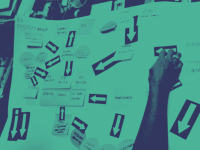
This toolkit allows organisations to change their mindset and move from a project-oriented approach towards a platform-way-of-working that is designed to tackle complex problems. The toolkit was developed and tested by the Danish Design Centre in collaboration with United Nations Development Programme (UNDP) and 40+ country offices. The toolkit consists of several mapping exercises. After using the integrated Mission Statement Generator to create an ambitious yet realistic mission statement,…
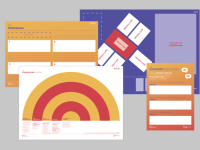
The REMODEL toolkit is targeted at companies producing products and is focused on developing economically sustainable business models through the principle of open source. While the toolkit is private-sector-oriented, some of the co-creation principles and methods can also apply to some areas of the public sector. The toolkit was published based on the experience of REMODEL with 8 Danish companies in 2018. The toolkit consists of 7 work packages and each part has a step-by-step instruction and a…

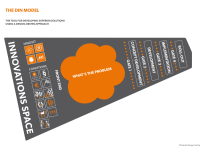
The DIN model is a methodology for developing solutions using a design-driven approach with the goals of achieving better and more innovative processes and outcomes, increasing probability of implementation, and improving user satisfaction. The model helps explore all the potential pitfalls, possibilities and limitations, particularly in the "front end" or early stage of projects. The DIN model consists of a series of phases and four ‘gates’. Each phase contains a variety of activities and…

This resource is a series of tools to help clarify, plan, collect, and use data, information and evidence to evaluate an innovation as well as spread the learnings and results. It is intended to be used throughout a project to incorporate evaluative and intentional processes and feedback loops.
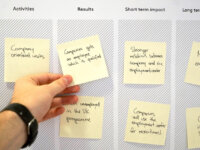
[Now defunct. Link goes to internet archive from 2018, when MindLab closed]. One of the pioneers of public sector design, Mindlab, developed a set of tools to find and define problems as well as new approaches to solving them. This toolset contains some of the most commonly used in the design practice (user journey, pattern recognition, etc).
The National Centre for Public Sector Innovation in Denmark has developed this guide to help public sector workplaces share their own innovations and reuse others. It is relevant for anyone who wants to collaborate on spreading an innovation from one context to another. The guide consists of six steps with recommended actions to take and associated tools that help structure the dialogue throughout the process.