
The transition game is an adapted version of “Le jeu de la transition” developed by the French Think Tank FING (Fondation Internet Nouvelle Génération) and adapted to a national defence environment, covering topical areas such as cyber and information warfare, man-machine teaming, and situational awareness and reconnaissance.
It guides groups through several steps:
1) Think about how different context factors and "internal tensions" shape today's state (ordering principles, norms,…
Toolkit Format: Game

Our Futures is a game for discovering new ways of engaging the public in thinking about alternative futures. The basic premise of Our Futures is that participants are randomly offered a series of constraints by drawing cards and rolling a dice, which serve as a primer for imagining a participatory futures activity. The game is played either with a group of individuals competing against each other or in teams in 30-75 minutes. The game has three different gameplay models of varying scope and…

The IoT Service Kit is a board game that brings domain experts out of their silos to co-create user-centric IoT experiences. The Kit consists of three major components: maps, tokens and cards, which can be downloaded and printed/3D printed. It includes source content on GitHub as well. Its stated goals: achieve mutual understanding, stay tangible, and make complex simple. It is best for those who have some understanding of service design processes and principles as well as IoT technologies.
The Open Data Board Game is a board game built around the creation of tools using data. A physical board game journey might involve clearing datasets for release as open data, achieving a certain data quality, and ultimately connecting data sets with a start up, SME or government to deliver economic, social and environmental benefits.
It is a Github code repository that contains all the things that are needed to create the game. It is a work in progress, according to the publisher. Requires some…

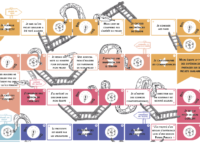
Designed with the assistance of the CNFPT and the DGAFP, this game is inspired by "Chutes & Ladders": a board game where the team must realize the major stages of their project, and sometimes encounters ladders (these "little miracles" that win several boxes at once) and chutes (these pitfalls that push back the project carrier). The resource is in French.

Here you find a selection of the Danish Design Centre’s commonly used tools. It includes information about the methods, instructions for tool use, and printable materials.
The tools are divided in three categories that are used at different stages in the design process - and often in this order: Explore, Co-create, and Give the future concrete form.
Explore helps the participants to open up and get around all aspects of the issue. Co-create contains tools that help participants get in-depth…
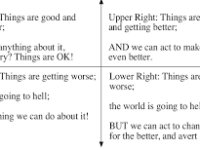
Over a dozen years of use to date, the game represents an accessible approach to introducing "images of the future" as a basic property of both cultures and individuals, and can be used as an introduction for more advanced futures and foresight tools and frameworks. It provides a structure for facilitating conversation among groups of participants and intended for groups. Duration is flexible, but typically runs 30-60 minutes. The resource provides step-by-step guidance for how to run the game…
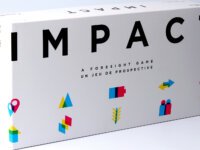
IMPACT: A Foresight Game is a serious board game that teaches you to think critically and imaginatively about emerging technology and the future of society.
It's goals for players:
/ Learn the basics of futures thinking including some of the key terminology
/ Learn about the latest advances in science and technology (neurotech, nanotech, artificial intelligence, IoT, biotech, robotics)
/ Practice thinking about how these emerging technologies could evolve and the various ways they could…
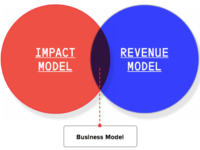
A Role-Playing and Ideation Game That Simulates The Process Of Launching A Social Enterprise. The game walks players through a series of activities in order to simulate the process of ideating and launching a social enterprise in four steps: Learn, Invent, Program, and Report. It is available via a pay-what-you-want digital download, and includes instructions for gameplay, a glossary of 200+ business models, and a suite of other resources.
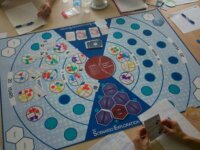
The Scenario Exploration System (SES) is a serious game for future simulation (2035 and 2050). It involves participants exploring their long-term objectives in contrasting scenario-related contexts while interacting with other stakeholders. By creating a realistic journey towards the future, the SES generates a safe space to simulate possible responses connected to any issue of interest to the participants.
There are two editions: "Sustainable Transitions" and "Food Safety and Nutrition…