
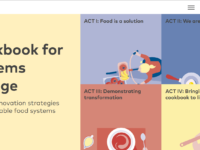
This cookbook of strategies for change is about the role that a strong public innovation system plays along the pathways towards sustainable food systems.
The publishers demonstrate this through a mission approach for deliberate food system transformation that can support people, planet and society. This strategy cookbook includes templates for developing interventions, guides for how to get started and examples of cross-cutting projects – that can be used to create recipes for change. The…
Country Territory: Finland
The UserCentriCities (UCC) Service Design toolkit is a curation of handbooks and tools to support the adoption of a user-centric approach in the design of digital public services. Compiled in collaboration with OECD OPSI Toolkit Navigator, it collects the most relevant tools and methods for cities, regions, and municipalities to use. It contains methods and handbooks developed and utilised by the UserCentriCities partner cities and regions network in their own user centric service development,…

Futures Frequency is a workshop method for groups of 8–20 people. This website provides tools for facilitating the workshop either online or in person. There are videos that introduce each theme and the facilitator’s handbook includes detailed steps for facilitating the group assignments.
Futures Frequency was developed by Sitra based on input from a development team in various fields. It's purpose is to increase participants’ ability to envisage different futures and take action towards…
This toolbox is a guide for shaping the future and developing organisational operations. It guides users through how to build an organisation’s future capability to ready it to deal with new phenomena. It guides users through all the steps of building a vision and for viewing, interpreting or shaping futures. It contains three phases: Trends and Signals, Interpretation and choices, and Shaping futures. Each tool includes step-by-step guidance and downloadable resources.

The Service Sandbox is a visual, playful, co-creation tool that allows individuals to explore digital services in a tangible and interactive way. The sandbox can be used to test an existing service or to create new ones. The resource is oriented toward designing interior environments, especially digitalising environments, but could be used more broadly. The tool consists of three phases (build, ideate and define), plus a pitch template for taking the process one step further. According to the…
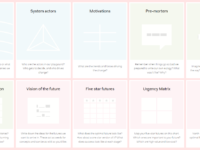
This resource is a modular set of tools (10 methods in 3 phases) that can be run in various ways, from a general tool to discover and ideate futures into a premeditated, repeated and ever-focusing exercise to build a vision on one or more lines of work. The resource can also be used to bring transparency and alignment to any organization through repeated exercises. It consists of three types of tools: Worldbuilding, Predictive Analysis and the Optimal Futures. The authors also suggest a process…

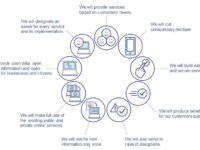
Established in 2016, these 9 principles provide guidelines for information sharing and interfaces, operating models, rapid service development and preparedness within the Finnish government and beyond.
The Experiment Co-Creation Platform (ECP) is a model for collaboration and experimenting dedicated in delivering sustainable solutions to wicked urban problems.
The ECP model was developed and prototyped by Demos Helsinki. In the model, cities, higher education institutions and non-academic collaborators such as companies and foundations together define a desirable shared vision to work towards to as well as identify the challenges preventing the vision from happening. Research-based teams…
A guided introduction to 14 common service design tools, such as empathy maps, personas, and customer journeys. They are organised by the publisher's methodology: Define, Learn, Solve, Test. Toolkit. The publisher offers a suggested path through the tools but the publisher suggests that each can be used on their own. The toolkit is available via website in exchange for your email address.